Contents
- 1 American Flag Etiquette for the 250th Anniversary
- 1.1 What the American Flag Actually Symbolizes
- 1.2 A Brief History of the American Flag
- 1.3 U.S. Flag Code: American Flag Etiquette Rules Every Citizen Should Know
- 1.4 When Flags Fly at Half-Staff — Half-Staff Etiquette
- 1.5 Choosing the Right Flag for the 250th Anniversary
- 1.6 How to Build a Complete 250th Display
- 1.7 External References & Further Reading
- 1.8 Frequently Asked Questions About American Flag Etiquette
American Flag Etiquette for the 250th Anniversary
American flag etiquette isn’t complicated, but it does have rules — codified in federal law (the U.S. Flag Code) and refined over 250 years of national tradition. Specifically, we’ll cover what the flag represents, the U.S. Flag Code rules every American should know, half-staff etiquette, choosing the right flag for the 250th anniversary, and how to retire a flag with dignity.
What the American Flag Actually Symbolizes
Before diving into American flag etiquette rules, it helps to understand why the flag is treated with such care. The flag isn’t just fabric — it’s a national symbol with specific meanings encoded into its design.
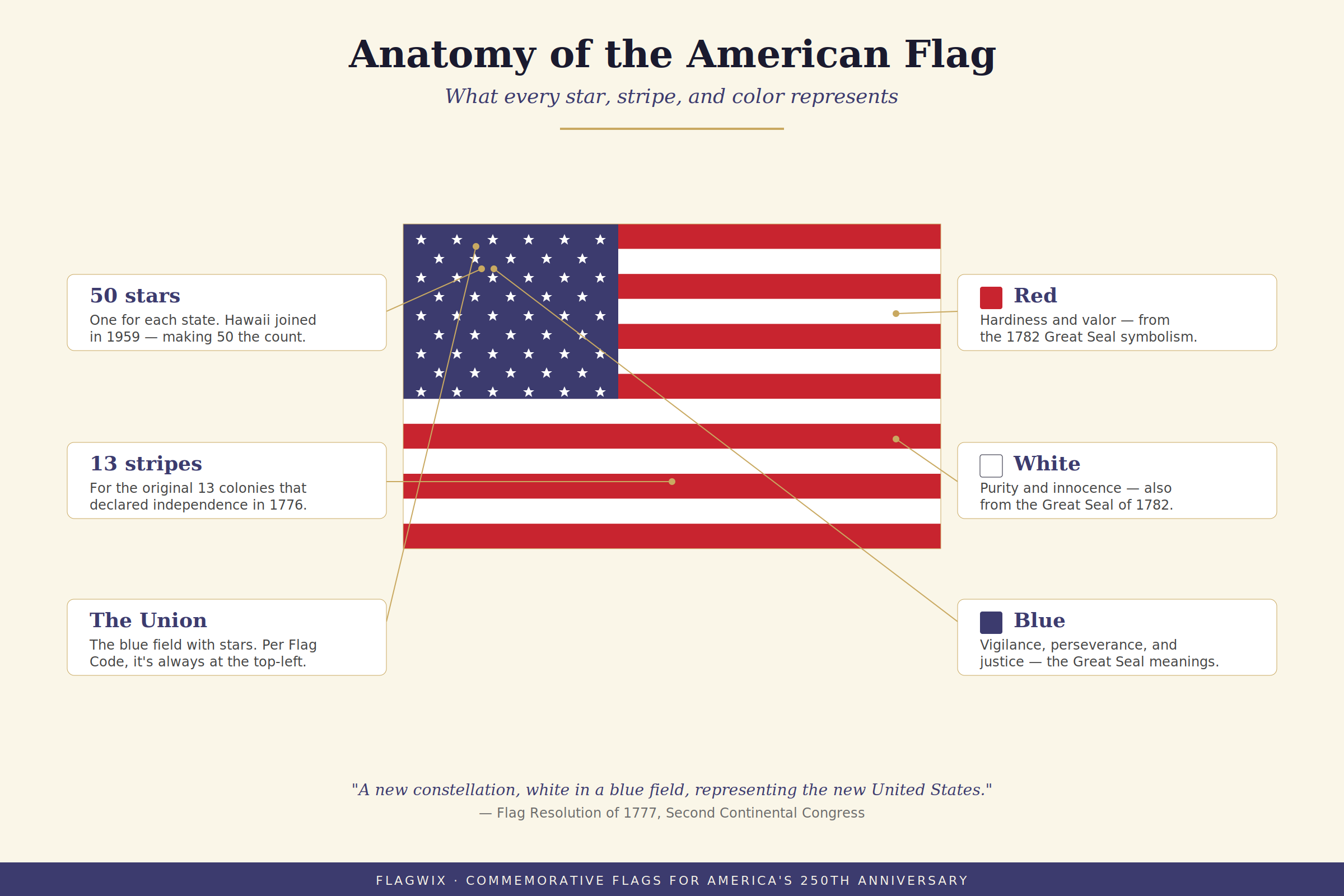
The 13 stripes represent the original 13 colonies that declared independence in 1776: Connecticut, Delaware, Georgia, Maryland, Massachusetts, New Hampshire, New Jersey, New York, North Carolina, Pennsylvania, Rhode Island, South Carolina, and Virginia. Seven red stripes alternate with six white — the colors chosen to represent valor (red), purity (white), and justice (blue, in the canton).
The 50 stars represent the 50 current states. The star pattern has changed many times since 1777, but the meaning has stayed constant: each star is a state, equal to all others, united in a single field.
The blue canton (the rectangular blue field in the upper-left corner) represents vigilance, perseverance, and justice. The Continental Congress chose these symbolic colors deliberately — they aren’t accidents of dye availability or 18th-century fashion.
When American flag etiquette treats the flag as more than fabric — when we hoist it briskly at sunrise, lower it ceremoniously at sunset, never let it touch the ground — we’re acknowledging that the symbol is bigger than any one of us. That’s the foundation every flag etiquette rule rests on.
A Brief History of the American Flag
The flag we know today wasn’t the first American flag, and it won’t be the last. Therefore, understanding the history helps explain some of the flag etiquette rules that might otherwise seem arbitrary.
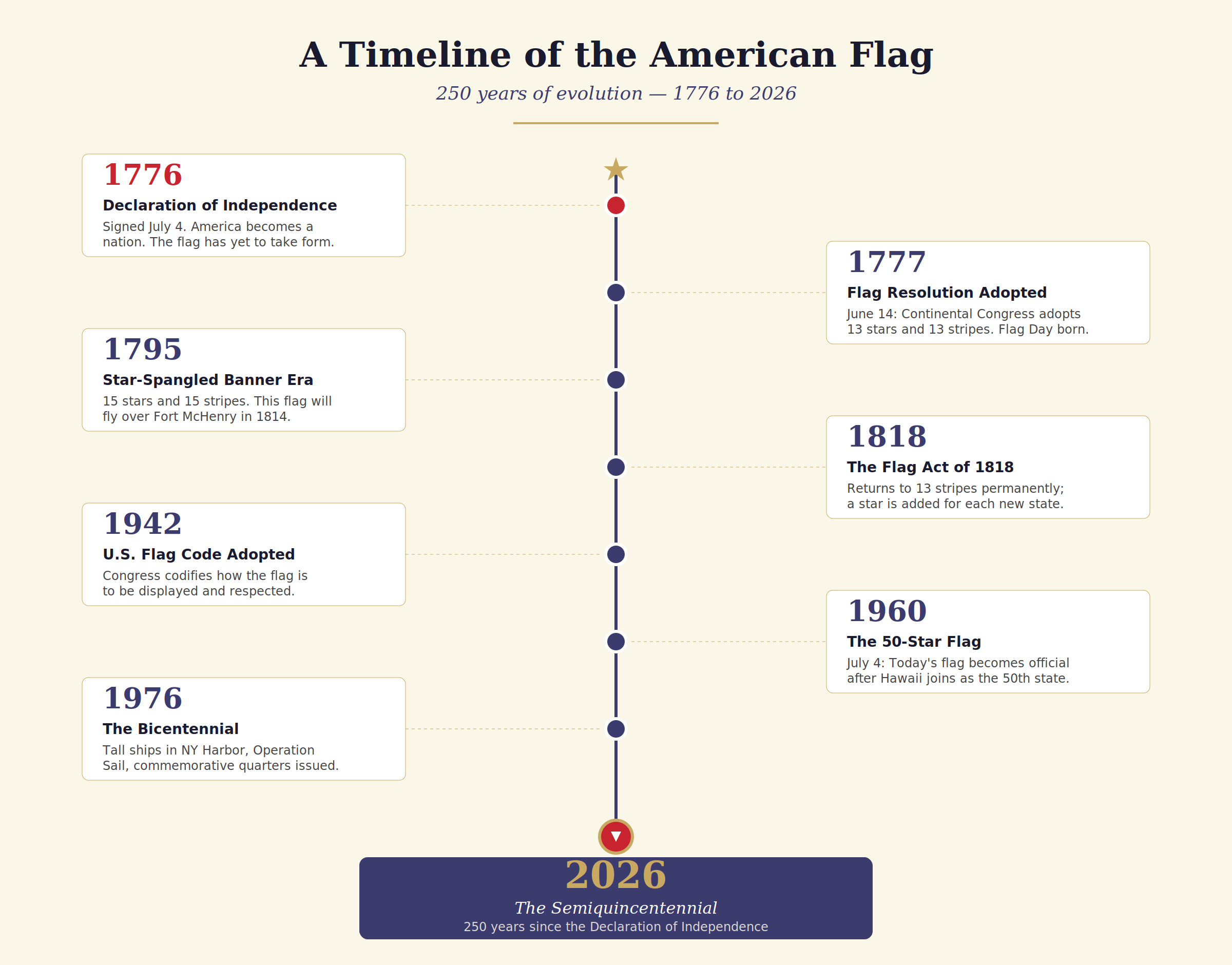
Initially, the Continental Congress passed the Flag Act of 1777, establishing 13 stripes and 13 stars. Subsequently, the design commonly attributed to Betsy Ross — 13 stars in a circle — emerged from this resolution.
As more states joined, the flag evolved. However, the rule established in 1818 still applies today: stripes stay at 13 (representing the original colonies), and a new star is added for each new state.
During World War II, Congress codified standard rules for American flag etiquette into the U.S. Flag Code (Title 4, U.S.C.). Notably, when Hawaii became the 50th state in 1959, President Eisenhower personally selected the current 50-star design — the flag that will mark America’s 250th anniversary on July 4, 2026.
U.S. Flag Code: American Flag Etiquette Rules Every Citizen Should Know
The U.S. Flag Code (Title 4, U.S.C. §§ 1–10) defines proper American flag etiquette for federal buildings, civic organizations, and private citizens. While the Code is non-binding on civilians, it represents the authoritative standard for flag display in the United States.
When to Fly the American Flag
Standard flag display etiquette under the Flag Code:
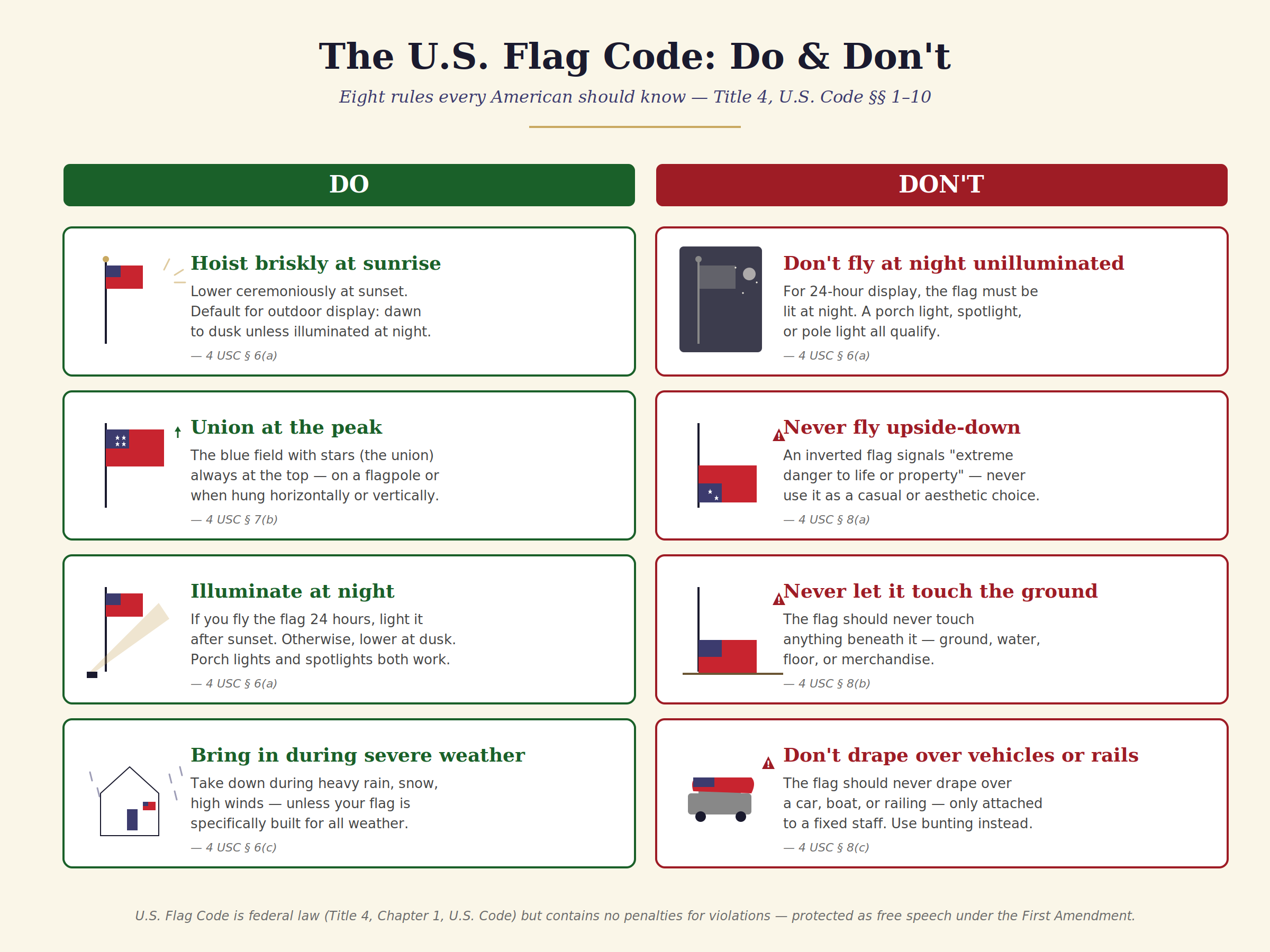
- Hoist briskly at sunrise, lower ceremoniously at sunset. Flags should be raised quickly with energy and lowered slowly with respect.
- Display only during daylight hours — unless the flag is properly illuminated. A porch light, spotlight, or floodlight pointed at the flag satisfies this requirement.
- Bring indoors during severe weather (heavy rain, high winds, snow) unless your flag is specifically labeled “all-weather.”
- Fly flags every day if desired — the Flag Code permits continuous display when illuminated at night
Recommended American flag etiquette holidays for display:
- New Year’s Day (January 1)
- Inauguration Day (January 20)
- Martin Luther King Jr. Day (3rd Monday in January)
- Lincoln’s Birthday (February 12)
- Washington’s Birthday / Presidents’ Day (3rd Monday in February)
- Easter Sunday (variable)
- Mother’s Day (2nd Sunday in May)
- Armed Forces Day (3rd Saturday in May)
- Memorial Day (last Monday in May) — half-staff until noon, then full
- Flag Day (June 14)
- Father’s Day (3rd Sunday in June)
- Independence Day (July 4) — particularly meaningful in 2026
- Labor Day (1st Monday in September)
- Patriot Day (September 11) — half-staff
- Constitution Day (September 17)
- Columbus Day (2nd Monday in October)
- Navy Day (October 27)
- Veterans Day (November 11)
- Thanksgiving Day (4th Thursday in November)
- Christmas Day (December 25)
How to Position the Flag — Display Etiquette
Next, these positioning rules apply whether you’re flying a flag from a porch, flagpole, wall mount, or indoors.
For vertical or horizontal display (against a wall): The union (blue field with stars) goes in the upper-left as the viewer faces the flag. Notably, this is the most commonly violated rule in American flag etiquette.
When hanging from a flagpole: Always position the union at the peak, never inverted. However, an inverted flag is reserved as a signal of extreme distress — never decorative.
Behind a speaker: Place the flag behind the speaker on the wall. Specifically, the union goes to the speaker’s right (the audience’s left).
When Flying Multiple Flags — Hierarchy Etiquette
A common scenario in 2026: you want to fly your 250th anniversary commemorative flag alongside the standard American flag. Flag etiquette has clear rules for this:
- Same flagpole: American flag at the top, commemorative or state flag below
- Separate poles, same height: American flag in the position of honor (the viewer’s left as they face the flags)
- Separate poles, different heights: American flag must be on the higher pole
- Wall display side-by-side: American flag on the left as the viewer faces it
- Crossed indoor display: American flag on the viewer’s left, with its staff in front of the other flag’s staff
These rules apply whether the second flag is a state flag, a 250th anniversary commemorative tribute, a service-branch flag, or a religious organizational flag.
Common Flag Etiquette Violations
Furthermore, the Flag Code identifies these common violations to avoid:
❌ Letting the flag touch the ground, water, or floor
❌ Using the flag as drapery, festoons, or rosettes
❌ Using the flag for advertising in any form
❌ Drawing on or marking the flag in any way
❌ Displaying the flag with the union down (except as distress signal)
❌ Flying a tattered or worn flag — instead, retire it through proper ceremony
While the flag itself shouldn’t be used as decoration, flag-themed bunting is fully approved by the Flag Code. Per the Code:
“Bunting of blue, white, and red, always arranged with the blue above, the white in the middle, and the red below, should be used for covering a speaker’s desk, draping the front of the platform, and for decoration in general.”
When Flags Fly at Half-Staff — Half-Staff Etiquette
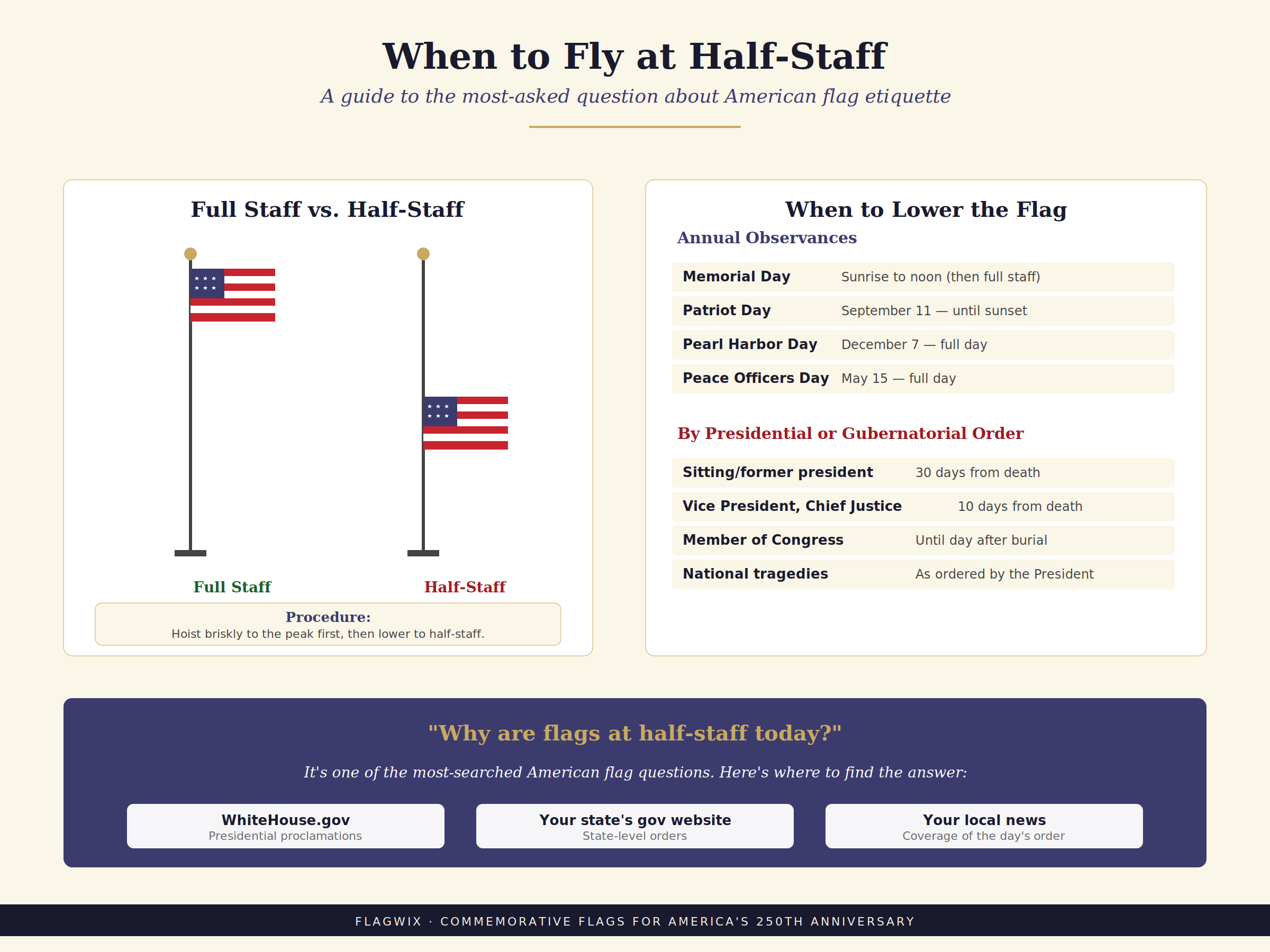
Half-staff display is one of the most visible aspects of American flag etiquette — and one of the most misunderstood. Specifically, half-staff display honors the dead and signals national mourning.
Annual Half-Staff Observances
Several days throughout the year call for half-staff display:
- Memorial Day (last Monday in May) — half-staff from sunrise until noon, then raised to full staff
- Patriot Day (September 11) — full day at half-staff
- Peace Officers Memorial Day (May 15) — full day at half-staff
- Pearl Harbor Remembrance Day (December 7) — full day at half-staff
- Firefighters Memorial Day (October 4) — full day at half-staff
Additionally, the President or state governor may order half-staff for the death of officials, military personnel, first responders, or during national tragedies.
When Your Flagpole Can’t Lower to Half-Staff
Sometimes residential flagpoles can’t be lowered (many porch-mounted poles can’t). In that case, Flag Code permits these alternatives:
- Attach a black mourning streamer to the flag’s top edge
- Or simply not fly the flag on half-staff days
Both options preserve American flag etiquette.
Choosing the Right Flag for the 250th Anniversary
In 2026, you’ll see many types of flags flying. Fortunately, flag etiquette allows for several distinct categories.
The Standard 50-Star American Flag
First, the flag of today — 13 stripes, 50 stars. Most American households fly this flag year-round. Importantly, flag etiquette treats this as the primary national flag, with all other flags subordinate. To complete your setup, pair it with a 6ft stainless steel flagpole kit for residential mounting.
Commemorative 1776–2026 Flags
Next, a 2026-specific category: flags incorporating “1776 — 2026” date framing or “250 Years” typography. Specifically, these are commemorative tributes designed for the milestone year.
When flying a commemorative flag alongside the standard American flag, proper flag etiquette requires the standard flag in the position of honor. For a complete selection, browse Flagwix’s full America 250th Anniversary collection for commemorative options across multiple themes:
- 250 Years of Freedom flags for the political milestone
- We The People 250 flags for Constitutional emphasis
- Betsy Ross 250 flags for 13-star heritage
- Eagle 250 flags for the bald eagle emblem
- 250 Years of Blessing flags for faith-forward designs
- Veterans 250 flags for service tributes
For format-driven shoppers who specifically need flagpole flags, browse the 250th Anniversary Grommet Flag collection — every theme above gathered in flagpole format.
Heritage and State Flags
Additionally, historical American flags (the 1777 Betsy Ross flag, the 1818 15-star “Star-Spangled Banner” flag) may be flown at private residences, historic sites, and ceremonial occasions. Furthermore, state-specific 250 anniversary flags blend state pride with Semiquincentennial framing — particularly meaningful for the original 13 colonies.
Patriotic Decoration
Finally, for decorative purposes, 250th anniversary bunting is the flag-etiquette-compliant alternative to draping the flag itself. Specifically, bunting drapes horizontally along railings, eaves, and parade routes — the festive complement to the dignified vertical flag.
How to Build a Complete 250th Display
Furthermore, here’s how to build a complete patriotic display for 2026 while honoring proper American flag etiquette:
- Main flagpole: Standard 50-star American flag at the peak, with a 250th anniversary commemorative grommet flag below
- Secondary pole: State-specific 250 anniversary flag
- Porch railing: Patriotic bunting draped horizontally
- Front walkway: Pet-themed 250th anniversary flags staked along the path (available in garden, house, and 3×5 grommet sizes)
Notably, this layered approach respects flag etiquette hierarchy (American flag highest), creates strong visual impact from the street, and lets every member of the household participate in the celebration.
Most importantly, even a single flag — properly displayed per American flag etiquette — is more meaningful than multiple flags displayed incorrectly.
External References & Further Reading
- America250 official site: — bipartisan initiative coordinating the Semiquincentennial
- White House Task Force on America 250: — federal-level coordination
- U.S. Department of State Freedom 250: — global engagement programming
Frequently Asked Questions About American Flag Etiquette
Can I fly the American flag at night?
Yes, as long as it’s properly illuminated. Specifically, American flag etiquette under the Flag Code permits 24-hour display when the flag is lit by a porch light, spotlight, or floodlight. However, without illumination, the flag should be lowered at sunset.
What is proper American flag etiquette for indoor display?
For indoor display, the union (blue field with stars) goes in the upper-left as viewed by the audience. Furthermore, when displayed behind a speaker, the flag is to the speaker’s right (audience’s left).
What’s the proper way to dispose of an American flag?
According to American flag etiquette, worn flags should be retired through a dignified ceremony, “preferably by burning.” However, in practice, take your worn flag to a local American Legion, VFW, or Boy Scouts post for proper retirement at no charge.
Can I display the American flag and a state flag on the same pole?
Yes — and flag etiquette has clear rules for this. Specifically, the American flag goes at the top, with the state or commemorative flag below. Furthermore, never fly any flag above the American flag on U.S. soil.
What does an upside-down American flag mean?
Notably, an inverted American flag is officially recognized as a signal of extreme distress under the Flag Code. Therefore, it should never be used as a political or decorative statement — that violates American flag etiquette and may be misinterpreted as a genuine emergency signal.
How do I display a commemorative 250th anniversary flag with the standard American flag?
Proper flag etiquette treats commemorative flags as subordinate to the standard 50-star flag. Same pole: American flag at the peak, 250th anniversary commemorative below. Separate poles: American flag in position of honor (viewer’s left or higher pole). Furthermore, this applies whether your commemorative flag is a Flagwix 250 Years of Freedom design, a We The People tribute, or any other 1776–2026 flag.
What’s the difference between US Flag Code and flag etiquette?
To clarify, the U.S. Flag Code is the federal codification of flag rules — a written legal document. On the other hand, American flag etiquette is the broader cultural practice that includes the Flag Code plus additional traditions like specific retirement ceremonies. In short, the Flag Code is the authoritative reference; flag etiquette is the lived practice.

I am a writer with a passion for flag history, symbolism, and design. I love exploring the deeper meanings behind flags and how they connect people, traditions, and personal expression.